
The context
Sport England work with partners with the aim of enabling everyone to enjoy the benefits of physical activity.
With a new strategy to implement that aimed to change how they worked with partners in the future, I was part of the team tasked with delivering tools and processes to make the relationships more consistent, more efficient and more effective.
This example comes work the team did on reporting.
The problem
Partners are required to report every 6 months. Following on from the work to change what partners report we also needed to look at how partners reported.
Feedback from partners had highlighted that the reporting process and specifically the system that was being used was a problem.
Evidence of this was that Sport England colleagues were spending a significant amount of time with partners helping people understand what to do.
OUR AIM: Changing the process of reporting
To improve how we communicate about the reporting process, making it more consistent, efficient and effective.
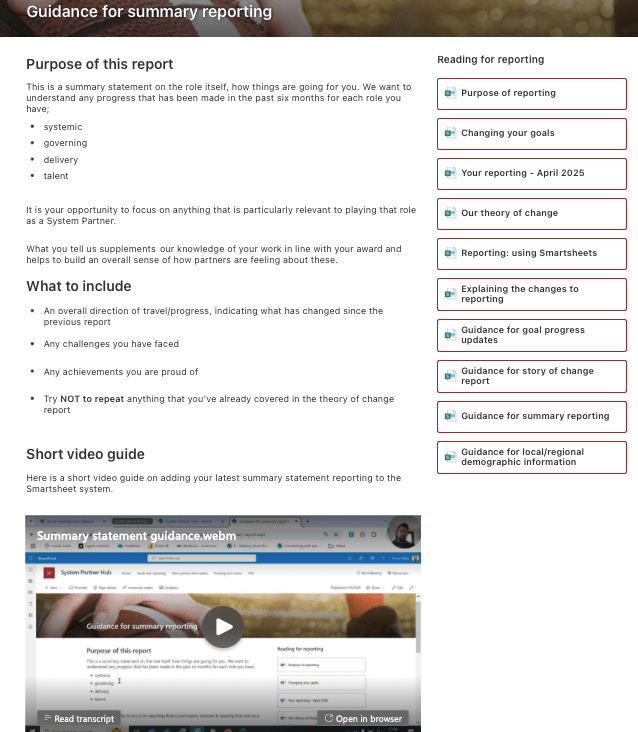
What was needed was a single source of the truth designed to focus on delivering clarity to partners about what’s required.
Research by another team who were building an information hub suggested that partners would appreciate the clear approach. And there was a plan that our teams would work together to create an area on the hub that would have all the reporting guidance and information for partners. However, by the time we were ready to collaborate that team were no longer around and the web presence they had secured was no longer available.
My role in the work
Having worked closely with the other team I was able to use what I’d learned to champion the need for a dedicated space for reporting information. When I shared this need with the team, they suggested that might be able to get a Sharepoint site. It was a good solution because:
- it was quick, we could be up and running within a week
- we would have control over the ability to publish
- our users would be able to access it through the Microsoft tools already in place
- it was a space already covered by the data policies in place
However I had never used Sharepoint before working at Sport England so with that blank canvas I needed to:
- design the look and feel of the space
- set up the information architecture and navigation
- create all the content and get it approved
- add all the content to the site
And to support the roll out of the new process I also created a content strategy for where content would sit across the platforms, as well as a communications plan.
Where I started
I reviewed the research we had around the process mainly partner feedback through survey’s and my observations from joining calls for the previous round of reporting.
As well as diving into what partners were telling us I also looked at what we were producing to support the reporting process. I discovered that:
- guidance was in the form of a Powerpoint document
- there were multiple versions of the document to account for all the changes
- because it was assumed that no one read the document a lot of the information was repeated in lengthy emails
- information was also repeated across several calls throughout the process
As I had been heavily involved in the design of the new process I was able to get started on the content quite quickly. I drafted in Word documents and added them to a shared folder, notifying stakeholders when content was ready to approve.
And I also began exploring SharePoint, using online resources to get enough knowledge to set up and design the site.
Learn and Test and Learn some more
Some key things I learned while doing this work:
- My original method for getting approval did not work.
Because we were building while delivering my stakeholders were otherwise engaged. To address this, I started to put the content directly into the SharePoint site to make it available to the whole team to look at when they had time. When it needed to go live I included it in the communications so everything got approved at the same time. - I needed a change process
When the approval process didn’t work as expected it had a knock on effect. The SharePoint site was not set up with access levels or an approval process. This became a problem when content was updated by others which was not in line with the rest of the site. I found out when it was reported by others on the team. To address this I worked with our delivery manager to design an implement a process involving a shared Trello board. - Co-creating comms on Miro
I worked closely with our subject matter expert to design the communications plan. I had to convince them that we needed to think strategically about what we said and when to make sure we didn’t add to the partner overwhelm. Together we used Miro to shape the content across the various channels, emails, video calls and the SharePoint site.
Research informed decisions
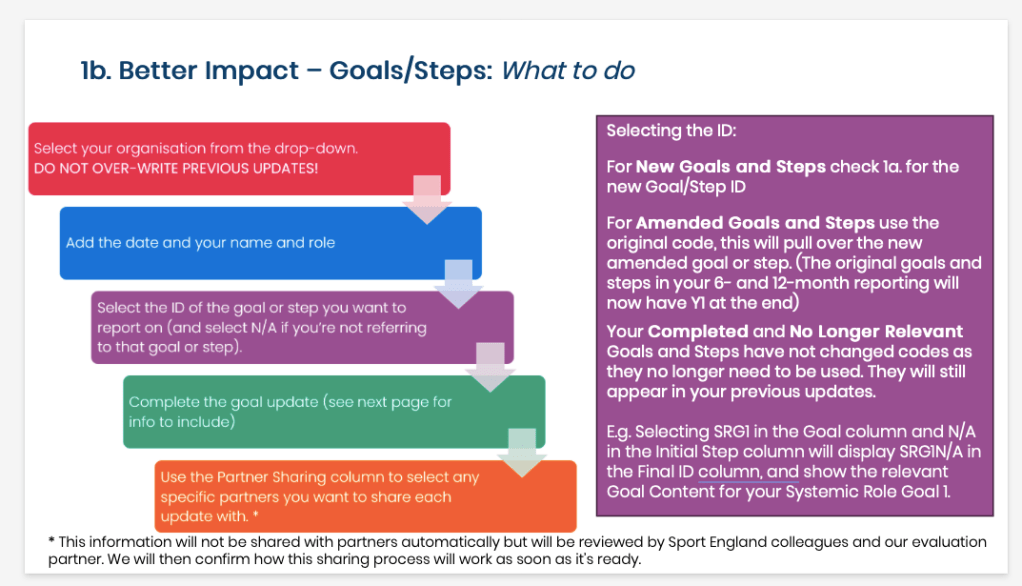
I also used the research to create the guidance that would accompany the new reporting. An example of one of the design decisions I made was to make sure there was a connection back to the wording in the original framework because I now knew that knowledge of the framework varied. It meant that some of the partners would be expecting to see something closer to original framework.
In what we delivered, we also made sure that a Word version was available to download. Even though this was a prototype, it proved to be a useful tool in helping partners to produce their reports before entering the information into our system as it could be easily shared with all the colleagues involved in producing the reports.
Outcomes
 FionaDoesDesign